

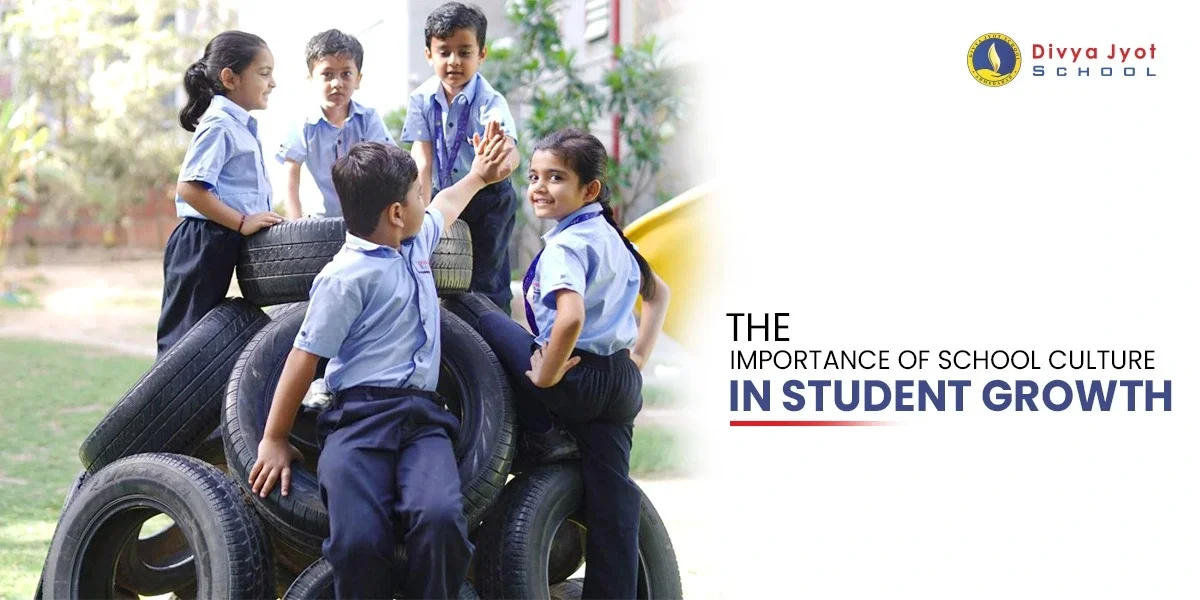
You just have to walk into a school, and you feel it. It is neither in the textbooks nor in the building. It breathes in the way the students welcome one another, the warmth in the voice of the teacher, and the certainty in the eyes of a child when he/she raises their hand.
School culture is that invisible presence-the heartbeat of any great institution.
When we speak about student growth, we tend to think about grades and curriculum. However, there is something stronger beneath all that: the environment in which young minds are taught to think, question, and develop. Positive culture not only enables children to excel in school, but it also makes them the people they are.
Students open their doors when they feel secure, appreciated, and noticed. They take risks. They do not fear making mistakes.
At Divya Jyot School, we believe true learning happens when a child feels connected. Let us explore why culture matters just as much as curriculum.
What Is School Culture?
School culture is the personality of a school. You feel it when you enter the building. It is reflected in the manner in which the teachers welcome students, whether the children should hold the doors open to one another, and what the school should welcome.
Most important is the student-teacher relationship. Friendly teachers provide such secure environments where children are not afraid of asking questions. Distant teachers make learning feel like a transaction.
Peer pressure affects everyday life as well. Students who collaborate support one another, and overly competitive students develop stress.
Traditions and values of the school form identity. Every child will feel like they belong when respect and kindness are the key drivers.
Extracurricular activities allow students to find out their untapped strengths outside the textbooks. These works determine the emotions of children daily. And the nature of their feeling determines the manner of their learning.
Student growth is about focusing on past grades. True development occurs when the child is developed as a whole-mind, heart, and belonging.
When school culture thrives, students thrive. That is what we build every day.
Why a Positive School Culture is Critical for Today’s Children
Childhood today is different. Our children are stressed at school, they have to compete with others at school, they spend hours and hours on the screen, and they carry the load of silent self-doubt. They do not necessarily get along in this world using textbooks alone. They require a location that keeps them in place.
Positive school culture is a kind of safety net. It picks kids up when they fall and allows them space to develop without fear.
Importance of school culture
Emotional Well-Being
When children are safe and appreciated, anxiety is relieved. They enter the door with the knowledge that somebody cares. Happiness is included in their daily lives.
Confidence and Self-Belief
A positive environment will motivate the children to raise their hands, innovate, and experiment. They are taught not to be afraid of making mistakes in the process of learning.
Curiosity and Love for Learning
When curiosity is praised, children ask questions. They experiment, ask questions, and cogitate on their own. Studying is no longer a burden.
Academic Growth
Students feel supported, and excellence naturally takes place. With an enabling atmosphere, they get the courage to go the extra mile and strive to reach greater heights.
Character and Values
When the children observe this in everyday life, respect, empathy, and responsibility will develop. They are taught to be nice to others and defend the good.
Interpersonal Skills
Positive environments promote teamwork and communication. Children are able to learn to listen, share, and work together, which they can use throughout their lives.
How to Choose a School with a Positive Culture
It is difficult to get into the appropriate school. You do not just desire good grades for your child. You want a place where they can feel safe, noticed, and enthusiastic to develop. This is where one can identify a school that has a culture of student development.
Visit the Campus
Walk through the hallways. Watch how students interact. Do they laugh with one another, open doors to one another, or do they walk with earbuds in their ears? As soon as you enter, you will feel the energy. An impression of a happy school environment is not one to be overlooked.
Talk to Students and Parents
Brochures make a beautiful impression. True dialogues express reality. Interview existing parents on what they like about the school and what they would like to see changed. Discuss with students their day. They will provide responses that will speak more than any site.
Look at Clubs and Activities
Pay attention to what is going on out of the classroom. Does school encourage sports, arts, music, and leadership programs? A balanced school provides each child with an opportunity to know their abilities, not only to excel in exams.
Check Mental Health Resources
Inquire about wellness programs and counselors. These matter deeply. A school that is keen on developing its students and cares about its students invests in emotional health as well as academic achievement. Children will develop well in all other aspects as their mental support is achieved.
Read the Mission Statement—Then Verify
Unless the school lives by words on a wall, they mean little. Is the mission a representation of your family values? And more to the point, do those values put themselves into practice when you pay a visit? Seek consistency between what they say and what they do.
Trust Your Instincts
Finally, trust how you feel. A school may be able to cross all the boxes and not feel right. Listen to your gut. You know your child best.
The decision to attend a school is among the most critical ones. You can relax, you can do it, you can ask the right questions; you just have to find a place where your child is not only going to learn, but you know, you can really grow.
Conclusion
One of the most emotional decisions that a parent makes is which school to attend. You do not just want a building with blackboards and classrooms. You need a place where your child can be safe enough to try, be supported enough to fail, and be encouraged to try again.
At Divya Jyot School, we have spent years building exactly that kind of place. Enter our gates, and you will see the difference. Children laugh freely. The teachers are familiar with each student’s name. The open-air campus is full of curiosity instead of being restrictive.
True education is what we feel makes more than report cards. It forms character prior to professions, values prior to triumphs, and humanity prior to achievement. It is not only our philosophy but also our demonstration of how we appear daily.
We are holistic in our approach to the child, whether it is experiential learning and sports or a nurturing environment where a child can always find a spark. We have parents who say that their children get up in the morning eager to go to school. That is a good thing to know, we are on the right path.
When you choose Divya Jyot, you choose a community that grows with your child-not just through exams, but through every stage of becoming who they are meant to be.
Come visit us. Walk our halls. Talk to our students. You will see what makes us different.
Your child’s journey matters to us. Let us begin it together.