

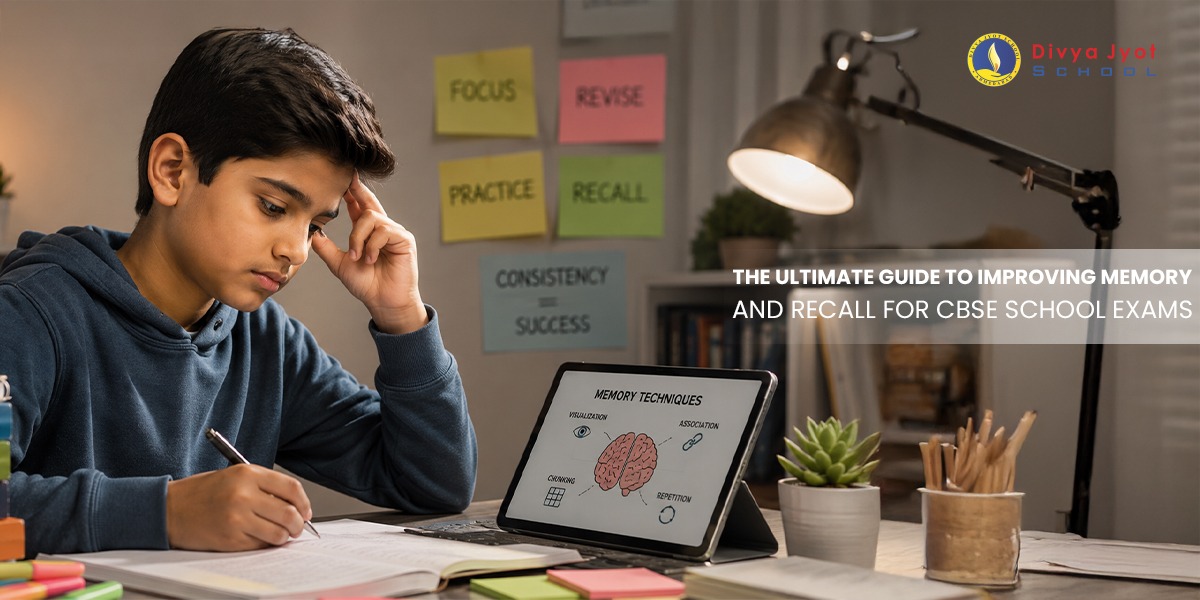
Every student has been there. You studied for hours, felt confident going in, and then sat in the exam hall watching everything you revised slowly disappear. It is one of the most frustrating experiences a student can face. And in most cases, it has nothing to do with how hard they studied. It has everything to do with how they studied.
CBSE board exam preparation demands more than long hours and highlighted textbooks. It demands the right strategy. Memory is not a fixed ability. It is a skill. And like every skill, it can be trained, strengthened, and used more effectively with the right approach.
This guide covers exactly that. Practical, research-backed memory techniques for students that work in real classrooms, real homes, and real exam halls.
Why Most Students Study Wrong
Here is something most students do not realize. Rereading notes feels productive. Highlighting textbooks feels thorough. But neither of these actually builds strong memory. They induce the illusion of learning in psychologists. The brain assumes familiarity with the material and considers it to be known. However, familiarity and recall are two very different things.
It is important to note that people who recognize something on a page are not the same people who can find it under examination pressure. This is where most students lose marks.
The fix is not studying more. The fix is studying differently.
The Active Recall Study Method
The active recall study method is one of the most effective memory strategies available to students preparing for high-stakes exams. It’s a simple but powerful concept. Don’t read your notes again, close them. Attempt to remember from memory what you’ve learned. Put it in writing, speak it out loud, or tell someone.
When you have difficulty finding something and then locate it, the memory link becomes stronger. Learning is a struggle itself.
Here are a couple of suggestions for using active recall daily:
- Read a chapter, then close it and write the things you recall.
- Rather than read definitions, use flashcards to test yourself.
- Solve old test questions, without looking at the notes first
- Teach a concept verbally, as it were, to a friend
- Finally, practice recalling the key concepts of each topic learned
The more like the real test, the more your brain works when it counts!
Spaced Repetition: Study Less, Remember More
A majority of students edit and move on to a topic once. That is the one primary reason why information goes by exam day. The brain is not programmed to retain information that it encounters only once.
Spaced repetition provides a solution to this. It involves reviewing the same material on a scheduled basis over days and weeks, rather than learning it all in one night. The more you rehearse something before your brain forgets it, the more firmly it will be rooted in there.
A basic spaced repetition program for a CBSE student:
- Day 1: Brief Notes & Research on Topic.
- Day 2: Test each other without the use of notes
- Day 4: “Review” and complete missing pieces.
- Day 7: Repeat self-testing
- Before the test: One last run-through of the material
With this method, the entire study time is used, but recall is greatly enhanced. Cramming is an aid to short-term memory. Spaced repetition creates an indelible memory.
Memory Enhancement Strategies That Actually Work
In addition to active recall and spaced repetition, there are also several other memory enhancement strategies that have demonstrated efficacy with school students.
Mind Mapping is for visual learners, as they link ideas instead of memorizing them. When we draw a topic in the form of a web of ideas, the brain has more than one route to access the same topic.
Mnemonics and Association work because it’s easier for the brain to remember unusual, funny, or personal information than it is to remember just plain facts. A rhyme, acronym, or story around a challenging concept will embed it for life that rereading will not.
The Feynman Technique is presenting a concept in the simplest terms, as you would to a younger student. Don’t bother trying to explain it if you can’t explain it in a simple way, you haven’t really understood it yet. This technique reveals to the student what they do not know in advance of the test.
Chunking is the process of dividing up large amounts of information into manageable units. Grouping information into 4 or 5 only sets to remember makes the information much easier to remember and retrieve than if there were 20 facts to remember.
Brain Exercises for Students
Brain exercises for students are not just about studying harder. They are about keeping the mind sharp, focused, and ready to absorb information.
- Practice full-day recall before sleeping. Sit quietly and replay everything that happened from morning to night. This trains the brain to store and retrieve sequences
- Do quick mental math without a calculator to build working memory
- Read for 20 minutes daily outside of textbooks. Fiction, news, anything. It builds concentration and vocabulary simultaneously
- Try memorising new information in a different location each time. Changing environments improves recall by creating distinct memory cues
These exercises build the mental stamina students need for long exam sessions where focus and concentration cannot afford to drop.
Focus and Concentration Tips for Exam Season
Even the best memory techniques fail if a student cannot focus long enough to absorb information in the first place. Focus and concentration tips matter just as much as study strategy during CBSE exam preparation.
- Study in blocks of 25 to 45 minutes with short breaks in between. The brain retains more from focused, shorter sessions than from exhausted, longer ones
- Keep the phone out of the room during study time. Even a phone placed face down on the desk reduces cognitive capacity
- Study the hardest subject during peak focus hours, usually in the morning for most students
- Stay hydrated and avoid heavy meals before a study session
- Get consistent sleep every night during exam preparation. Sleep is when the brain consolidates memory. Cutting sleep to study more is always counterproductive
How to Remember Answers in Exams
Knowing the material at home and retrieving it under pressure in an exam are two different challenges. Here is how to remember answers in exams when the pressure is real.
- Before writing, spend two minutes reading the full paper and letting familiar topics surface naturally
- Start with questions you are most confident about to build momentum and calm nerves
- If a specific answer is not coming, write related points around it. Often, the act of writing nearby information triggers the target memory
- Use keywords from the question itself as mental hooks to guide your recall
- Practice writing full answers under timed conditions before the actual exam, not just reading or making notes
The brain performs best under conditions it recognises. The more your revision resembles exam conditions, the more natural retrieval feels on the actual day.
Smart Study Techniques: The Daily Habit That Changes Everything
The students who perform consistently well in CBSE board exams are rarely the ones who study the most hours. They are the ones who have built smart study techniques into a daily habit.
- Review the previous day’s work for ten minutes before starting anything new
- Make brief notes in your own words, never copy text word for word
- Test yourself at the end of every study session, not just before the exam
- Identify weak areas early and give them scheduled time, not last-minute panic
- Track what you have revised and what still needs attention using a simple weekly planner
Consistency beats intensity every single time. Studying one hour daily across five days is far more effective than five hours on a single day.
How Divya Jyot School Prepares Students for Exam Success
At Divya Jyot School, we do not just teach the syllabus. We teach students how to learn. Our teachers integrate effective learning strategies into everyday classroom practice, helping students build the kind of deep understanding that holds up under exam pressure.
From structured revision schedules and concept-based teaching to regular self-assessment and personalised feedback, we equip every student with the tools they need to walk into their CBSE exams with confidence, not just preparation.
Conclusion
Improving memory is not about being naturally gifted. It is about using the right techniques, consistently over time. Active recall, spaced repetition, brain exercises, and smart daily habits are not shortcuts. They are the real way learning works. Start using them now and the difference will show up exactly when it matters most, in the exam hall.
At Divya Jyot School, we are committed to building students who are not just exam ready but genuinely equipped for lifelong learning. Admissions for 2026 to 27 are open. Visit our campus and see how we prepare every child to perform at their best.