Skip to content

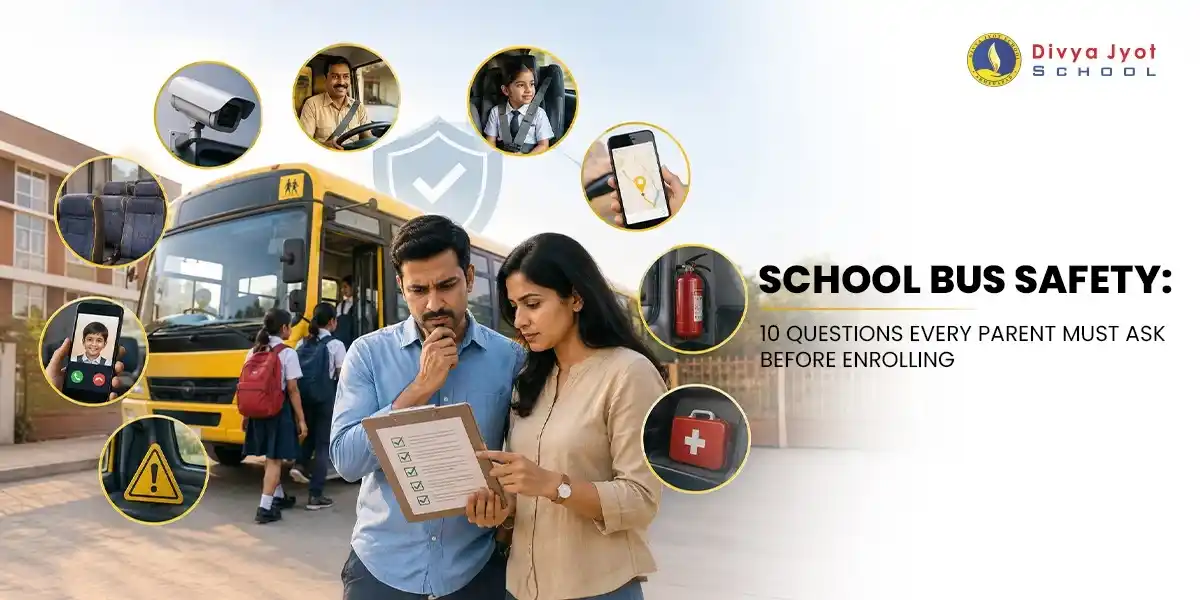
Each morning, thousands of parents leave their children to board a school bus in India. That wave is the trust. Believe that the vehicle is safe, the driver is well-trained, and your child will arrive at school and home with no damage to his or her car. However, how many parents take time to ask pertinent questions before signing their child up for school transport?
The primary concern of most parents in the process of admission is academics, infrastructure, and fees. Children’s safety on school buses is seldom at the top of the priority list. It should. Because the school bus is not just a convenience. It’s the start and finish time of your child’s entire school day, every day.
The following are 10 questions that all parents should ask before entrusting their children to any school to pick them up and drop them off.
1. Is the Bus Fitted with a GPS Tracking System?
This is non-negotiable. The CBSE Board has announced that GPS should be installed on all CBSE-affiliated buses. A real-time GPS allows parents to follow their kids’ footsteps, understand when they reach their destination, and alert them if something doesn’t seem right. Make sure to speak with the school before enrollment to find out if parents can access live tracking through the app or portal.
At Divya Jyot School, all the transport vehicles are fitted with GPS so that parents know everything and feel at ease about all their trips.
2. Is There a Speed Governor Installed?
The Supreme Court of India has stated that all school buses should have a tamper-proof speed governor of no more than 40 kmph. Children in a bus must never travel at speed in the street. Request that the school verify this and that it is checked on a regular basis. Safe school transportation begins with controlled speed, not good intentions.
3. Are CCTV Cameras Installed Inside the Bus?
CBSE has now made it compulsory to install CCTV cameras inside the bus. They have two functions. First, they prevent misbehaviour within the car. Second, they serve as a record to document problems if they arise. Inquire about the length of time that footage is stored and who has access to it at the school. Normally, per the regulations, the video should be preserved for at least 60 days.
4. Is a Trained Female Attendant Present on Every Trip?
Attending trained personnel aboard is a Supreme Court mandate, not an add-on. A female attendant is required for routes transporting female students. The attendant’s responsibility is to help children board and deboard the bus, to keep the children in order inside the bus, and to be ready to help a child if they need it. Inquire at the school whether their attendants are trained, verified, and present on each one of the trips without exception.
5. What Are the Driver’s Qualifications and Background?
The driver of a bus with children in the vehicle must meet specific requirements. According to the school bus safety norms for children in India, the driver should have a valid driving license for a minimum of four years with a clean driving record. A detailed background check should be done on any driver before they are hired. Request the driver’s credentials and inquire if the school conducts regular checks on all staff members who transport students.
6. Does the Bus Have a First Aid Kit and Fire Extinguisher?
These are simple school bus safety guidelines for parents that are frequently forgotten when parents get on board. All school buses in India must be equipped with a working first aid kit and a fire extinguisher. Regular checks for expiry and condition of both are necessary. Inquire with the school regarding the frequency of their inspections and who is trained to use them in an emergency.
7. Is the Bus Overcrowded?
One of the most prevalent school bus safety issues in India is overcrowding. Clearly from the Supreme Court rules, children under 12 years will not be seated more than 1.5 times the number of seats. You should not go past that point for safety reasons. Request the exact seating capacity of each bus and the number of children assigned to each bus from the school. A quality school will not do this.
8. What Happens If My Child Is Not Picked Up at the Drop Point?
Parents are one of the most likely groups to overlook this question prior to registering their children for school transportation. What is the school’s protocol if no authorized adult is present at the drop location? Does the driver return the child to school? Is there a notification system in place? Clarity on this procedure can prevent serious safety incidents. A well-managed school will have a clear, documented protocol for exactly this situation.
9. How Does the School Handle Transport Emergencies?
Accidents, breakdowns, and medical emergencies on the bus. While they are rare, they do happen. Inquire about the school’s plan of response in the event of an emergency. Has a transport manager been assigned? Does the driver know what to do in case of an accident? Are parents notified immediately? Child safety in school transport depends just as much on emergency preparedness as it does on daily routine.
10. Can Parents Ride Along to Verify Safety Standards?
This one surprises many parents,, but it is actually within your rights. Supreme Court guidelines permit a parent or guardian to travel on the school bus to verify that safety norms are being followed. A school that is confident in its transport standards will never refuse this request. If they do, that itself tells you something important.
How Divya Jyot School Handles School Bus Safety
The safe transportation of students is an integral part of the way we do things in Divya Jyot School. All of our vehicles are fitted with GPS trackers, speed governors, CCTV cameras, and trained attendants on each route. Drivers are checked, cars are properly maintained, and parents are informed throughout. We follow all CBSE and Supreme Court guidelines on school bus safety without compromise because your child deserves nothing less than complete safety from the moment they leave home to the moment they return.
Final Thought
School bus safety tips for parents in India are not just about rules and checklists. They are about asking the right questions before you hand over that daily trust. Do not hesitate to ask. A school that takes child safety seriously will always welcome the conversation.
Admissions at Divya Jyot School are open. Come visit us and see our transport standards for yourself.