
There was a time when a good student was simply one who remembered everything the teacher said. Memorise the formula. Reproduce the answer. Score the marks. Move on. That model of education is not enough anymore, and the CBSE education system knows it.
The world students are stepping into does not reward the best memorizer in the room. It rewards the person who can look at a problem, break it down, ask the right questions, and find a solution that did not exist before. That requires a very different set of skills. Skills that start building in school, or not at all.
Critical thinking is no longer a bonus trait in a CBSE student. It is a stated goal of the curriculum itself.
What the CBSE Education System Actually Says About Critical Thinking
The single change in the CBSE curriculum framework is to get rid of rote learning and promote real understanding. The board documents its curriculum itself, declaring that children need to be able to think laterally, critically, to identify opportunities, challenge their potential, and to be open to new ideas.
This is not philosophy! It appears in the design of the assessment. CBSE has officially added Higher Order Thinking Skills (HOTS) questions to the board exams for all subjects of Class 10 and 12. Competency-based questions (HOTS, case studies, source-based questions) have been included in 50 per cent of the total paper in NEP 2020, aligned with Class 10 and Class 12.
That is not a statement, and critically, that is a structural change in what studies and school and source-based are trying to produce.
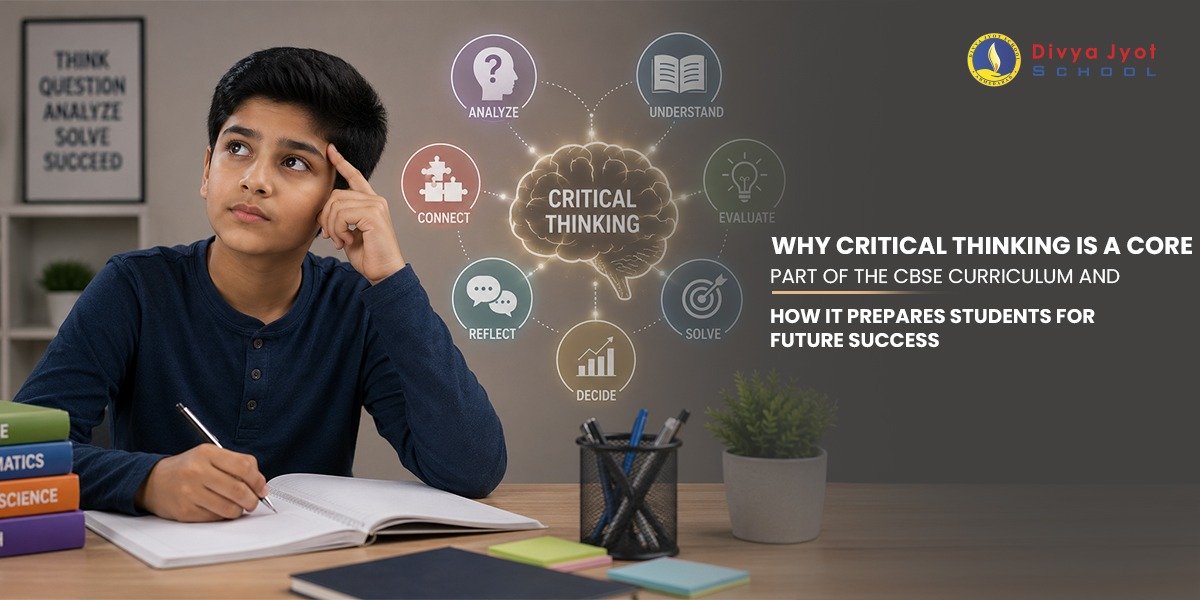
What Are Higher-Order Thinking Skills and Why Do They Matter
The higher-order thinking skills are at the apex of Bloom’s Taxonomy, which is a widely used taxonomy for learning and cognition. The lower levels of the taxonomy are for recalling and comprehending, while the higher levels of the taxonomy are for applying, analyzing, evaluating, or creating.
A simple HOTS question is not a “recall a fact” type. It provides them with a context they haven’t faced before and challenges them to apply what they know to solve the problem. This is what actually happens in the real world. In a job interview. In a boardroom. In a crisis.
Students who develop strong HOTS can:
- Analyze complex, without being given directions as to what to look for
- Critically assess the reliability of information and ideas from different sources
- Use information or knowledge from one area in a new and different area to solve a problem
- Be innovative where there is no easy solution!
- Decide with confidence when information is incomplete
These are not just ‘academic skills.’ They are skills for life that increase in value with age.
Inquiry-Based Learning: Asking Questions Is the Real Lesson
Inquiry learning is one of the most effective approaches to developing critical thinking. Inquiry-based classrooms start with a question, and students are encouraged to find out the answer. Inquiry-based classrooms begin with a question, do not give students the answer, and they have to discover it on their own.
It allows children to know that not knowing something is the beginning of learning, not a sign of failure. Develops curiosity, a “why” attitude, and confidence to explore instead of being told.
If a student investigates a science concept by observing and testing it instead of just reading it from a science book, he/she does not just understand that science concept. They develop a thinking process that they will use for the rest of their lives.
Numerous studies have demonstrated that the results of critical thinking, analysis of thinking, and creative problem-solving obtained by the method of inquiry-based is significantly better than the results obtained by the method of teaching in one direction. Many studies have shown that the results of critical thinking, analysis of critical thinking, and creative problem-solving obtained by the inquiry-based method are higher than the results obtained from teaching in one direction.
Student Centered Learning: Shifting the Role of the Classroom
Critical thinking is possible at scale because it is student-centered learning. In a regular class, the knowledge is in the teacher and is passed on to the students. Students are active agents in building that knowledge in a student-centered classroom.
More discussions in groups, project-based activities, debates, case studies, and solving real-world problems. It means that pupils explain their ideas rather than just their work. It involves teachers questioning with multiple possible correct answers.
This transformation alters the meaning that students have for school. It becomes a place where they feel their thoughts are valued, where their voice is heard, and where disagreement is treated respectfully and is seen as a sign of intellectual development, not defiant action.
Critical Thinking Activities for Students That Build Real Skills
Students’ critical thinking activities need not be difficult. They must be regular. These are the types of activities that promote genuine analytical and creative thinking over time:
- Debate and structured discussion: students debate both sides of an issue
- Case study analysis (use of textbook concepts in real-life situations)
- Open-ended science experiments; results are not known in advance
- Creative writing prompts, not formulaic answers.
- Discussions of current events that relate to the learning taking place and things happening in the world!
- Pupil-led, peer tutoring sessions in which students teach one another the concepts, using their own language
- Project-based learning is a problem-solving process with a set of problems that require a group to solve over a period of weeks.
These activities build analytical thinking skills, strengthen decision-making skills for students, and foster innovation and creativity in education in ways that no amount of textbook revision can replicate.
Problem Solving and Decision Making: The Skills Employers Actually Want
Talk to any employer about the skills they want in a young employee, and they will likely tell you it isn’t just about knowledge. Students’ abilities to problem-solve turn into workplace values. To be able to diagnose the problem, consider potential solutions, and to carry out a solution with certainty.
These skills are developed at school. Or they aren’t made.
Competency-based education is a direct outcome of CBSE’s response to the mismatch between what is being produced by schools and what is required in the world, which has been there for decades. A student trained for years to think and not memorize is different in his ability when he arrives at work. The student trained over the years to think rather than remember is different in his ability at work.
Decision-making skills for students are enhanced when there are dilemmas, trade-offs, and situations presented in the classroom where there is no right answer. These moments allow children to learn that it is important to think deeply about an issue rather than be certain.
21st Century Skills: What the Future Actually Requires
The phrase “21st-century skills for students” gets used a lot. But what does it actually mean for a child sitting in a classroom in Ahmedabad today?
It means the ability to collaborate across differences. To communicate ideas clearly in written and spoken form. To use technology as a tool for thinking, not just consuming. To adapt when the rules change. To create solutions that did not previously exist.
None of these skills comes from a textbook. They come from an education system that treats learning as an active, questioning, creative process. CBSE’s emphasis on HOTS, competency-based assessment, and effective learning strategies for students is precisely aimed at producing graduates who can do all of this.
Innovation and creativity in education are not subjects you can schedule once a week. They are outcomes of a classroom culture that rewards curiosity, supports risk-taking, and values the question as much as the answer.
How Divya Jyot School Builds Critical Thinkers Every Day
At Divya Jyot School, critical thinking is not a program we run. It is how we teach. Our classrooms are designed around student participation, inquiry, and application. Teachers encourage students to question, explore, and connect ideas across subjects. HOTS-aligned assessments are embedded into our academic planning from the early years so that students develop the thinking habits they need long before they face board exams.
From structured debates and project-based learning to open-ended problem-solving tasks and creative exploration, every element of our approach is designed to produce students who think, not just students who know.
We believe that the most valuable thing a school can give a child is not a score. It is a mind that knows how to work.
Conclusion
Critical thinking is not a subject. It is the outcome of an education done right. CBSE has made it clear through curriculum design, assessment reform, and its alignment with NEP 2020 that the future of Indian schooling belongs to students who can think deeply, question boldly, and solve creatively.
The schools that understand this are already building those students. The ones that do not are still teaching children how to remember.
At Divya Jyot School, we are committed to the former. Admissions for 2026 to 27 are open. Visit our campus and see how we are shaping students who are ready not just for exams but for everything that comes after.